
The Science of Making Mistakes
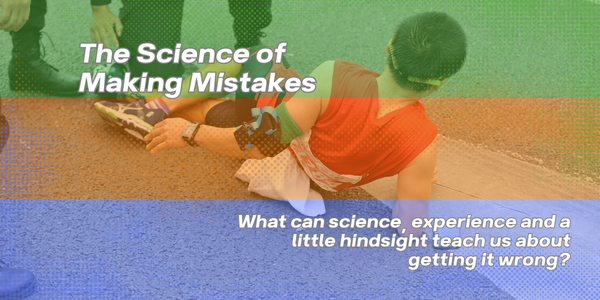
Why even the best athletes get it wrong — and what we can learn from them.
I've made a few mistakes in my years of racing triathlons. Some were obvious almost immediately. Others took a little longer to recognize. And I'm reasonably certain there were a few I never even knew I'd made.
That's part of racing. We make plans, prepare for every scenario we can imagine, and then head out on race day with the expectation that we'll execute those plans to the best of our ability.
And sometimes, despite all that preparation, we get it wrong.
But why? Why do intelligent, experienced, exceptionally well-prepared athletes make decisions that, in hindsight, seem so obviously wrong?
As it turns out, there's some science behind that.
When the plan meets reality
The 2026 IRONMAN World Championship in Kona provided plenty of opportunities to examine that question.
Gustav Iden received a three-minute drafting penalty on the bike. He went on to finish second, just 1 minute and 35 seconds behind Vincent Luis. Did that penalty cost him the world championship? Mathematically, it's tempting to say yes. But racing doesn't work quite that neatly.
Jamie Riddle also received a drafting penalty before eventually withdrawing from the race, although a reported sciatic nerve problem complicated his day considerably.
And then there was defending champion Solveig Løvseth, who appeared to have the women's title within her grasp before collapsing less than a kilometre from the finish. She eventually walked across the line in eighth place.
Three very different situations. Three outcomes that certainly weren't in the race plans.
But were they mistakes?
A drafting penalty is a consequence of a rule violation, whether the athlete intended it or not. An injury isn't a mistake. And watching an athlete collapse tells us very little about the physiological circumstances that brought them to that point.
It's easy to judge decisions from the comfort of our couches, particularly when we already know how the story ends.
It's considerably harder to make those decisions in the middle of a race.
Your brain gets tired, too
We spend an enormous amount of time training our bodies to perform under stress. But racing also places demands on our ability to think, interpret information and make decisions.
Fatigue, heat, discomfort, emotional pressure and the constant demands of competition can affect attention and judgment. We may become less flexible in our thinking, more focused on immediate goals and less receptive to information that challenges what we expected to happen. And sometimes, we just zone out before we realize we're within a drafting zone.
There's also the powerful influence of commitment.
You've spent months preparing. You've invested time, money and enormous emotional energy in a particular outcome. When things start going wrong, changing the plan can feel uncomfortably close to giving up.
So you push a little harder. Ignore a warning sign. Convince yourself that things will come around.
Sometimes they do.
Sometimes they don't.
And that's where the distinction between determination and good judgment becomes interesting.
We have more data. Do we have better decisions?
Today's athletes have access to an extraordinary amount of information. Heart rate, power, pace, training load, recovery metrics, nutrition calculations and sophisticated predictions of what we should be capable of doing.
I'm a fan of data. I use it myself, judiciously.
But I don't necessarily let the numbers dictate how I race or train.
If an effort feels particularly hard, I might check my heart rate. Depending on what I see, I can decide whether it's an effort I can reasonably sustain or whether I need to back off.
The sensation comes first. The data provides context.
And sometimes the numbers and the sensation don't agree. That's not necessarily a reason to dismiss either one. It's a reason to pay attention.
Heart-rate data isn't infallible. Neither is our perception of effort. Both are affected by circumstances, and both require interpretation.
Data can inform a decision. It can't make the decision for us.
And the more we depend on technology to tell us what we're experiencing, the more important it becomes to recognize what we're actually feeling.
The difference between a mistake and a bad outcome
Here's something else worth considering.
Not every bad result comes from a bad decision. And not every good result proves that the decisions were right.
An athlete can take a calculated risk, execute it perfectly and still lose. Another can make a questionable decision and get away with it.
We tend to judge decisions by their outcomes because the outcome is what we can see.
But if we're genuinely interested in learning, we need to look a little deeper.
What information was available at the time? What was the athlete trying to accomplish? Was the decision reasonable under the circumstances? And what, if anything, could have been done differently?
Those questions are more useful than simply deciding someone should have known better.
They also apply to the rest of us, whether we're chasing a world championship, a personal best or simply hoping to have a good day at our next race.
Learning to change the plan
Perhaps one of the most valuable skills we can develop as athletes is the ability to recognize when the original plan is no longer the right one.
That doesn't mean abandoning our goals at the first sign of difficulty. Thats' just not something endurance athletes do. We find our way through a challenge — we adapt.
It means understanding the difference between discomfort we can manage, a challenge we can overcome and a warning we shouldn't ignore.
We can practise that in training. We can experiment with pacing, nutrition and changing conditions. We can learn what different levels of effort feel like, how our bodies respond and when the numbers support or contradict our perceptions.
And after a race, we can look back with curiosity rather than judgment.
Sometimes we'll discover something we could have done better. Sometimes we'll recognize that we made the best decision we could with the information available.
And sometimes, despite everything we know, we'll still get it wrong.
That's not necessarily failure. It's experience. As I've said in many workouts, failure is feedback.
After more than three decades in triathlon, I certainly haven't run out of things to learn.
In fact, I've learned so much from my mistakes, I'm thinking of making a few more.
Triathlon, IRONMAN, Kona 2026, IRONMAN World Championship, Race Day Strategy, Triathlon Training, Sports Psychology, Mental Resilience, Athlete Decision Making, Performance Data, Racing Mistakes, Lessons from Racing, Endurance Sports, Athlete Resources


Comments