
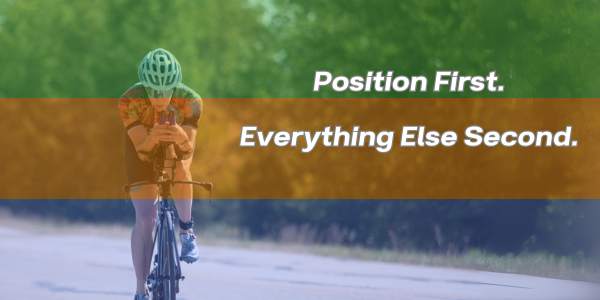
Position First. Everything Else Second.
Why Comfort and Fit Matter More Than Most Triathletes Realize
Triathlon can be an intimidating sport.
There is always a new bike, a new wheelset, a new helmet, a new hydration system, or a new aerodynamic claim competing for your attention. Social media and marketing often make it feel like getting faster is mostly about buying more equipment.
But after years of fitting athletes, building bikes, and watching people race, we keep coming back to the same conclusion:
Position first. Everything else second.
The single biggest performance factor on a triathlon bike usually is not the frame, the wheels, or the newest aero accessory.
It is the rider’s position.
And more specifically:
Can you comfortably hold that position for the duration of your ride and still produce power?
That is where most of the speed comes from.
Comfort Is Not the Opposite of Speed
A lot of athletes still think that “aero” means:
- lower
- more aggressive
- less comfortable
- more extreme
Sometimes athletes assume that discomfort is simply part of being fast.
But discomfort usually creates problems.
If your position is too aggressive:
- you sit up more often
- you move around excessively
- your neck and shoulders fatigue
- power output drops
- handling becomes unstable
- nutrition and hydration become harder to manage
In other words:
Aero only works if you can stay aero.
That is why one of the phrases we use often is:
Comfort = speed you can hold.
The best triathlon position is not necessarily the lowest position.
It is the position that balances:
- aerodynamics
- sustainable comfort
- power production
- stability
- mobility
- rider confidence
That balance looks different for every athlete.
The Biggest Gains Usually Come From Fit
Deep-section wheels, hydration systems, aero helmets, upgraded aerobars, race clothing, and premium components can absolutely provide meaningful marginal gains.
But those gains are usually built on top of a properly dialed-in position.
If the foundation is wrong, expensive upgrades often do very little.
We regularly see athletes riding:
- bikes that are too large
- positions that are too aggressive
- front ends that are too low
- extension setups that do not support their wrist angle
- hydration systems that make it difficult to stay comfortably aero
The result is usually the same:
The rider spends less time in aero position than they should.
And that matters far more than most people realize.
A slightly less aggressive position that an athlete can comfortably maintain for an entire race is often faster than a theoretically “more aero” position that constantly breaks down.
You Do Not Need a $10,000 Bike to Go Fast
This surprises a lot of people.
The internet can make it feel like triathlon success requires an extremely expensive bike.
In reality, many athletes can achieve excellent positions:
- on a road bike with aerobars
- on an entry-level tri bike
- on a properly fitted triathlon bike under $4000
A good fit and smart setup decisions often matter far more than chasing the most expensive frame.
That does not mean premium bikes are meaningless.
High-end bikes can offer:
- better integration
- improved aerodynamics
- cleaner cable routing
- lighter weight
- more adjustment options
- higher-end ride quality
But none of those things replace a sustainable position.
The fastest bike in the world cannot help very much if the rider cannot comfortably stay in position.
Small Changes Can Make a Big Difference
One of the most overlooked parts of bike setup is how small adjustments can dramatically change comfort and performance.
Sometimes the solution is not a new bike.
Sometimes it is:
- a different aerobar extension shape
- more front-end stack height
- a better armrest position
- a front hydration setup that is easier to use
- saddle adjustments
- a shorter reach
- improved cockpit support
These changes can improve:
- comfort
- stability
- confidence
- power production
- hydration consistency
- time spent in aero position
That is why fit is so individual.
There is no universal “perfect” triathlon position.
There is only the position that works best for your:
- body
- mobility
- flexibility
- injury history
- riding style
- race goals
The Same Principle Applies to Wetsuits
Interestingly, this same philosophy carries over into other parts of triathlon.
We recently talked about wetsuit fit and why buying based only on hype or marketing usually does not work very well.
The best wetsuit is not automatically the most expensive one.
It is the one that:
- fits your body properly
- allows good shoulder movement
- supports good body position
- lets you swim comfortably and efficiently
Again, comfort matters.
Not “comfort” in the sense of being loose or casual.
But comfort in the sense that your equipment works with your body instead of against it.
That principle applies to:
- bikes
- aero position
- cockpit setup
- hydration systems
- wetsuits
- race-day gear choices
The athletes who perform best over long distances are often the athletes whose equipment allows them to stay efficient for the longest amount of time.
Sustainable Speed
Triathlon rewards sustainability.
That is true physically, mentally, and mechanically.
The athletes who consistently perform well are not always the athletes with the most expensive gear.
Often, they are the athletes who:
- understand their bodies
- understand their position
- ride efficiently
- stay comfortable under fatigue
- make smart equipment choices
- avoid chasing every trend
That is why we believe:
Position first. Everything else second.
And why:
Comfort = speed you can hold.
Because in triathlon, sustainable speed usually wins.
If you have questions about bike fit, aero setup, cockpit adjustments, or triathlon bike options, we are always happy to help.


Comments