
Aerobars Then and Now: A Journey Through Design and Innovation
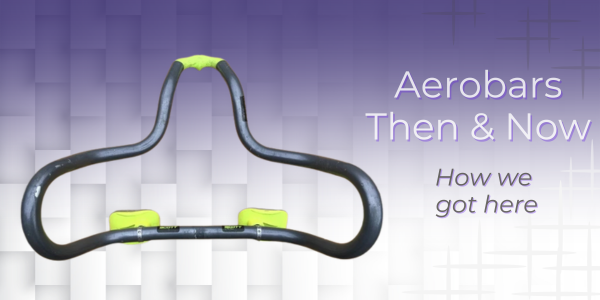
f you think today’s aerobars are high-tech, take a moment to appreciate how far we’ve come. The origins of the aerobar are debated — some credit Pete Penseyres, others Boone Lennon. In our household, Cam credits the Scott DH bar and early ski-racing experimentation which is in line with other historical accounts. Regardless, the first aerobars were simple, rough, and often hand-bent, yet they delivered a performance advantage that paved the way for decades of innovation.
In the 1980s, prototypes appeared in the Race Across America, and through a mix of tinkerers, coaches, and athletes, designs evolved — inline brakes, S-bend extensions, and eventually molded carbon fiber platforms. Even early designs achieved what mattered most: better posture, improved aerodynamics and a measurable edge on race day.
Fast-forward to today: aerobars are almost a race in themselves. Every new model touts incremental gains, full carbon molds, integrated armrests, and precision adjustability. The technology is incredible, but it can also be as overwhelming as it is inaccessible.
That’s why the smart approach is grounded in your needs. When selecting an aerobar, consider:
- Price vs value: Expensive doesn’t always equal faster.
- Adjustability & fit: A bar that adapts to your position and comfort is critical.
- Retrofit options: Can it work on your bike? Many of the new generation won't fit on legacy bikes.
- Availability: Make sure replacement parts are accessible.
- Accessability: New designs are popping up faster than ever. Many can be difficult to get when quanities are limited and demand is high.
By focusing on these decision criteria rather than chasing the latest hype, you can choose an aerobar that truly improves performance — just as the aerobar pioneers did decades ago, with simpler tools but the same goal: ride faster, ride smarter.
Here are some keys point to remember:
- Remember that comfort is still key: if aerobars put you in a position you can't hold, they aren't for you.
- Many of the new designs are designed as part of an integrated basebar, requiring a full cockpit rebuild, increasing the cost.
- Many ofhte new designs can't be retrofitted to legacy bikes.
- Being able to get into a comfortable, sustainable aero position is going to do most of the aero benefit for you. The simpler designs like the Zipp Vuka series and the Profile T-series can still be good options.
| Then | Now |
 |
 |



Comments